The world of leadership is filled with confident voices. These voices say they know what to do, how to do it, and where to go next.
But does confidence belie competence? Does confidence ensure things will get done?
We all know the answer is a resounding NO. Then why are we attracted to confidence?

Photo by Trevin Rudy on Unsplash
I believe it’s due to the ‘fake it till you make it’ mindset. We believe we need to project an air of confidence, even when we’re unsure of what we’re doing. We keep pushing forward, and eventually, we get things right.
In the meantime, our confidence leaves a wake of dead bodies. We need better.
4 Reasons We Need More Deep Thinkers
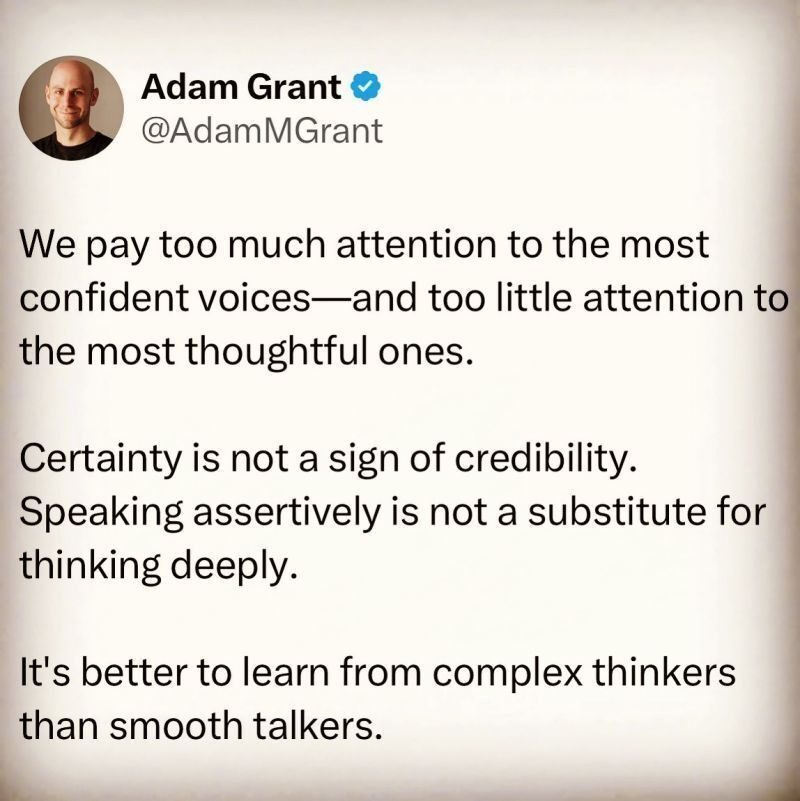
I love what Adam Grant had to say on Twitter/X about this. He said:
We pay too much attention to the most confident voices – and too little attention to the most thoughtful ones.
Certainty is not a sign of credibility. Speaking assertively is not a substitute for thinking deeply.
It’s better to learn from deep thinkers than smooth talkers.
 So, why do we need deep thinkers? Why should we look for people who ponder over people who exude confidence? There are four reasons…
1. Smooth talkers often don’t know what they’re talking about:
Have you been around a smooth talker? They say just the right words. They try to make you feel like they know what they’re talking about.
Then you get down to brass tacks.
The smooth talker stumbles over everything. They begin to show their true colors… They’re empty and hollow. There was nothing to back up their words.
2. Deep thinkers have considered multiple options:
Deep thinkers don’t jump on the first thought that comes to mind. No, instead, they choose to look at the possibilities from various angles.
They look for options A, B, C, D, and Z. They want to know they’ve covered their bases and thought through the process.
Deep thinkers aren’t looking to jump at the first great idea. They’re looking to chew through their ideas until they know they have a good one.
3. Smooth talkers often jump from one thing to the next:
I’ve watched the online space for almost two decades. I’ve seen smooth-talking heads online shift from one grift to another.
They see what’s popular, coming soon, or could blast off… then they shift their focus. I’ve seen experts in leadership become experts in cryptocurrency, only to shift to AI when their platform failed to explode in the cryptocurrency space.
They grifted from one topic to another. They weren’t deep thinkers. They were people looking to make a buck.
That’s often what happens with smooth talkers.
4. Deep thinkers often have a deep-seated confidence:
While smooth talkers have an outward confidence, deep thinkers have a deep-seated, often unseen confidence. They’ve run the scenarios, understand their actions, and have worked through issues that may arise.
Their confidence is firm. They just know it will work.
We need more deep thinkers around us. People who will challenge their long-held beliefs and think through complex situations.
Who’s the deep thinker in your organization? Could it be you?