One Battle After Another is a film by Paul Thomas Anderson. It’s the story of a washed-up revolutionary, Bob (Leonardo DiCaprio), who lies in a constant state of paranoia. He’s also constantly finding his next high in drug use.
All the while, he’s supposed to be caring for his daughter, Willa (Chase Infiniti). Yet, she seems to be the one caring for him.
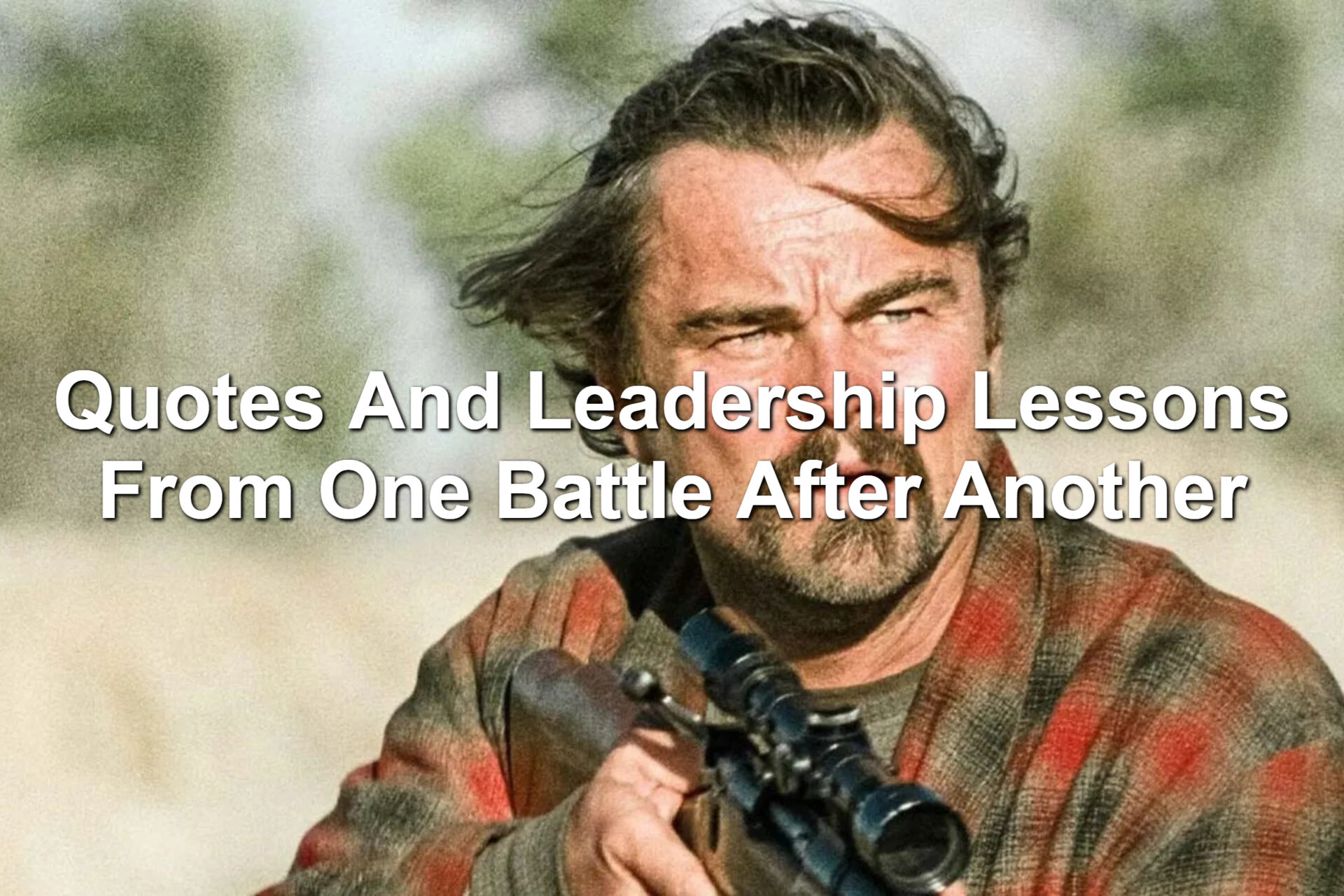
When trouble from Bob’s revolutionary days comes back, he has to get some of the old gang back together. They must protect Willa!
Bob and Willa’s journey in One Battle After Another sets a decent backdrop for discovering leadership lessons. While I found less in this film than in others, there are still bright, shining spots of leadership to be found.
Let’s look at those.
Quotes And Leadership Lessons From One Battle After Another
1. Bob:
From here on out, it’s one battle after another.
Leonardo DiCaprio’s character Bob utters the movie’s title shortly after planting bombs for his revolutionary group, the French 75. He was talking to his girlfriend, Perfidia (Teyana Taylor), and another revolutionary.
He knew once the bombs went off, it was going to be battle after battle after battle. There was no going back. This was the defining moment of their revolution.
Guess what else is one battle after another? Whether we want to admit it or not, leadership is one battle after another.
You’re constantly fighting fires, helping others, and seeing new issues. Battle after battle isn’t a bad thing. It’s a reality.
Lead with this in mind.
2. Bad leaders think of themselves first:
A sad thing happened after Willa was born. Perfidia grew more and more distant. She began to feel like she was less than after having a baby.
Why did this happen? Perfidia had thought of herself first. She continued to think of herself first, even after the birth of her child.
As she thought more and more of herself, she thought less of her baby and boyfriend. They became afterthoughts. Even to the point of her turning over the names of the members of the French 75 to Col. Steven J. Lockjaw (Sean Penn) to save herself. This cost members of the rebellion their lives.
Great leaders think of themselves, but they don’t think of themselves first. They think through how their actions will affect others:
- Their team members
- Organizational leaders
- Families
- Customers
- Vendors
They know they have to make decisions. However, they also know their first thoughts can’t be of themselves but of those they lead and serve.
3. Bad leaders turn on their teams:
We know that Lockjaw turned Perfidia. This occurred during a bank robbery that went awry.
Lockjaw offers Perfidia her freedom for information on the other revolutionaries. Perfidia hesitated at first. Then she began to give names. She offered up her people for her own gain.
We’ve seen this plenty of times. Leaders often find themselves in challenging situations. The only out is to throw a team member under the bus.
Did you hear the thump? That was the bus running someone over.
Great leaders don’t throw their team members under the bus. They push them out of the way, they look for ways to keep them safe.
Don’t turn on your team when times are tough.
4. Bad leaders feel morally superior to others:
Lockjaw desired to join the Christmas Adventurers Club. The Christmas Adventurers Club was a secret organization of powerful white supremacists.
In the club, they talked about being morally superior men. They believed themselves to be above reproach. The finest the world had to offer.
Yet, they weren’t. They were nasty, dirty men, especially Lockjaw.
Great leaders know they’re not superior to those they lead. They may have had better breaks, more opportunities, or favor shone upon them, but they are not superior.
Thus, they don’t treat their team members as inferior. Rather, they treat their team members as equals.
5. Have a backup plan:
Howard Sommerville (Paul Grimstad) was the revolutionary known as Billy Goat. He’s a radio broadcaster letting the world know the truth.
In one scene, Avanti (Eric Schweig), a military specialist, kidnaps Sommerville. He takes Sommerville to an undisclosed location to interrogate him.
Two young boys see Sommerville taken. They rush into his house after the abduction. There, they find his radio equipment and begin to broadcast a message:
Rise and shine! Billy goat is in the wind! I repeat, Billy goat is in the wind!
Sommerville had a backup plan in case he was ever taken. Someone would be there to broadcast a message to let those listening know there was danger.
What’s your backup plan? What happens if you were to die, go into the hospital, or fall off the grid? Would your organization be able to continue?
Great leaders know they won’t be around forever. They know something could happen and their people need to know what to do after that.
Have a plan that your people can execute in case anything happens to you.
6. Be prepared to answer questions:
Bob had to escape when the military came for him. He fled through a hole in the floor of his house. When he got out, he immediately called an underground resistance member.
The resistance member asked for a code word. Bob, with his drug-fried brain, couldn’t remember the code words. He was furious.
However, the resistance member wouldn’t disclose the information without the proper codes. Bob wasn’t prepared to answer the questions presented to him.
Important questions will be asked of you. People will desire to get the answer.
Will you have it? That depends on whether you prepared or not. Great leaders prepare for what may be asked of them. Be a leader who prepares.
7. Sensei Sergio St. Carlos (Benicio Del Toro):
I need your help.
Sensei was at a store he was very familiar with. There was a lady there that he spoke to briefly.
All he told her was four simple words. He said I need your help.
It’s not easy to ask for help. You’ll struggle to get the words out. You may feel that leaders shouldn’t have to help.
But they do. And they do it with ease.
Great leaders recognize that they can’t lead effectively on their own. They need the experience, expertise, and help of others.
Don’t be afraid to ask for help.
8. Bob:
I got lazy. I stopped paying attention.
Bob never thought any of the events in the movie would happen. But they did. And everyone was in danger because of it.
What had happened? Bob was in the car with Sensei when he admitted he had become lazy. He had stopped paying attention.
When we become lazy or stop paying attention, that’s when things really go awry. Our inattention to details or thinking of what is next will bring about a lot of trouble.
Stay on guard. Be vigilant. Don’t get lazy.
9. Great leaders help others take action:
Sensei had told Bob to jump out of the car on the count of four. He counted but Bob wouldn’t jump. Sensei knew he had to help him get out of the car.
What did Sensei do? He made an extreme turn that ejected Bob from the car.
Sensei helped Bob take action.
I don’t want you to throw anyone from a moving vehicle. However, I want to make you aware that you will be called upon to help others take action.
What kind of action? It could be:
- Helping them continue their education
- Finding a new career path
- Initiating a new project at work
Great leaders aren’t afraid to step in and help people get going.
10. Your tone will affect your organization:
The music in One Battle After Another was very jarring to me. It had a dissonant tone.
Every time the music played, I was jarred out of reality. It seemed that way for the rest of the theater as well.
The dissonant tone had a profound impact on everyone watching the film.
Your tone has an impact. The way you talk, the tone you give, will send a message to your people.
It could be jarring, disturbing, or confusing. Or you could have a tone that invites a sense of calmness and relief.
The choice is up to you. Choose your tone to set the tone of your organization.