Phillip Vanderploeg (Brendan Fraser) is a struggling actor in Tokyo. He’s seen success in the past. Yet, these days, it seems he can’t land that big break.
That’s where Shinji Tada (Takehiro Hira). Shinji runs an agency called Rental Family. It’s a revolutionary business that hires actors to stand in for family members, lovers, friends, and more, depending on the client’s needs.
With Phillip’s skills as an actor, he would be able to blend into the different situations he’s placed in. He could pretend to be almost anyone.
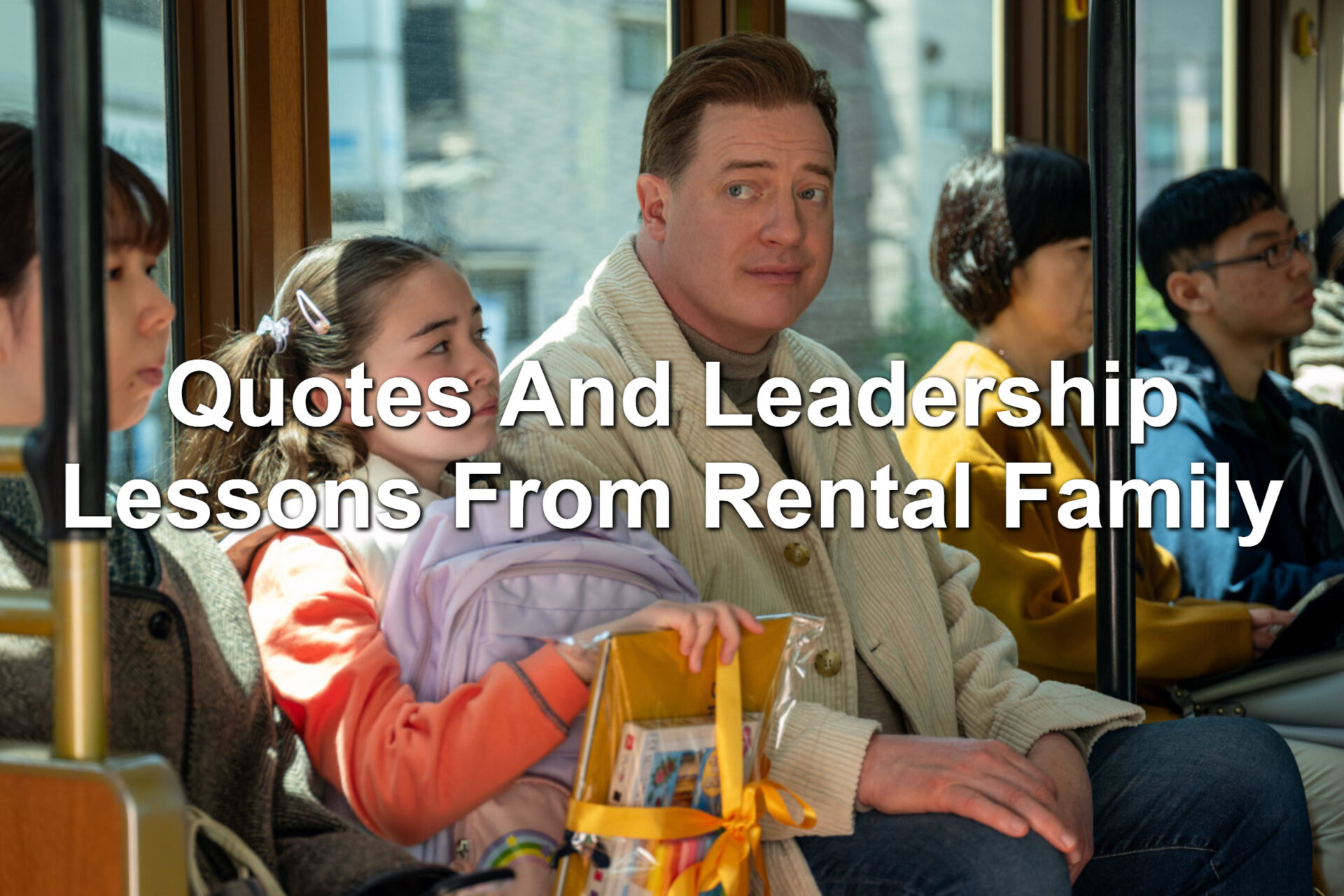
And that was the point. He could play a role, move on, and get paid regularly.
That was until Phillip found an attachment to the people he was hired to interact with.
Rental Family is a cute, endearing, yet sad look at how people live their lives these days. Alone, disconnected, longing for someone to be there.
We’re going to look at Rental Family through the eyes of a Reel Leader. Let’s discover those leadership lessons hidden in this moving film.
Quotes And Leadership Lessons From Rental Family
1. Phillip:
What’s my role?
Phillip is sitting in his apartment when he gets a phone call from an agency. They’re looking for an American for a role.
The caller asks Phillip if he has a black suit. He’s told the role pays well.
Then Phillip asks the important question: “What’s my role?”
The caller tells him his role will be the Sad American.
When you start at an organization, you need clarity. Asking “What’s my role?” will help you bring clarity to an often unclear situation.
The same goes for hiring new people. Give them information about the role. Fill them in on what’s going on.
2. Shinji:
You could live in this country for 100 years and there will still be things you won’t understand
The role of Sad American wasn’t for a TV show or movie. No, Phillip had been hired to be a Sad American for a funeral.
After the funeral, Phillip asks Shinji whether it was fake. Shinji replied that the funeral was real to Daitoh (Shôhei Uno). Even though it was a mock funeral to boost Daitoh’s ego.
Shinji then asks how long Phillip has lived in Japan. Phillip had been there for 7 years. Shinji let him know that he could live in Japan for 100 years and still not understand everything.
This is the case in organizations. Regardless of how long you have been in an organization, there will be things that you never understand.
Don’t fret.
Keep learning and growing about the organization. Find what’s happening, who is who, and what needs to be done.
The more you dig in, the more you’ll know.
3. Connection matters:
Phillip is a little taken aback by what Rental Family does. The company doesn’t sound like something he wants to be a part of. In fact, he believes Rental Family sounds as if it is selling people.
Shinji assures him Rental Family does not sell anyone. Rather, they sell connection. They help people heal, move on, and grow.
Shinji had something right with Rental Family. Connection matters.
Bob Burg, in his book Endless Referrals, states that “All things being equal, people will do business with, and refer business to, those people they know, like, and trust. That’s connection.
Connection makes us want to be with others. It makes us want to do business with them and help them thrive.
Build connections. Connection matters more than almost anything else in business.
4. Leaders believe in their people:
Phillip almost botches the role of a groom. He couldn’t bring himself to play the role and hid out in the bathroom. That is, until Aiko Nakajima (Mari Yamamoto) comes to find him and convince him to finish the job.
He does. And he realizes why they do what they do.
Shinji presents another job to Phillip. His next role is that of a father to a little girl, Mia Kawasaki (Shannon Mahina Gorman). Aiko is hesitant. She doesn’t believe Phillip can handle the role as he almost failed to play the role of a groom.
Shinji disagreed with Aiko. He said Phillip could do the role.
Organizations can breed dissent. People will believe others can’t do their role effectively. Especially after a mishap.
Your role as a leader is to come alongside the person struggling. You are to coach, encourage, and remind them that they can do what they were hired to do.
Believe in the people you have. You will bring out the best in them.
5. Phillip:
I want to try to understand.
Akio was visibly upset. She left the meeting and went to a ramen restaurant and bar. Phillip finds her there.
When Phillip finds Akio, she tells him that he knew what the job entailed. And he almost ruined it. She went so far as to call him a Gaijin. That he didn’t understand.
Phillip tells Aiko that he wants to understand. He’s willing to work on it.
There’s a lot of stuff in leadership that we won’t understand. Those could include:
- Why does someone act the way they do
- How come we can say one thing one day and it’s okay but the next day it is offensive
- Where someone comes from
It’s okay not to understand. What you can do is to work on understanding. Try to figure out these things. Work with your team to figure things out.
6. Great leaders invite others in:
Mia had a class visitation where they were making animals out of recycled materials. Phillip sits with Mia. Then she walks away.
Mia walks to a young boy who has no one with him. She asks the young boy if he wants to come over to their table.
And, this part was heartbreaking, Mia asks Phillip if he could be the young boy’s dad as well.
She invited someone into her little family.
Mia exemplified leadership in this moment. She saw someone who was alone. She knew she had an answer. And she invited the boy to join them.
She invited the boy into something he didn’t have.
Who are you inviting in? Who do you notice who needs someone to be with them?
Don’t ostracize them. Instead, ask them to join you. Bring them in.
7. Leaders need to be with their families:
Masami Hasegawa (Sei Matobu) reached out to Rental Family on behalf of her father. She knew he was mentally declining. As he declined, he feared he would be forgotten. She wanted her father, Kikuo Hasegawa (Akira Emoto), to know he wouldn’t be forgotten.
Rental Family sent Phillip over as a reporter. He quickly formed a bond with Kikuo.
Kikuo opened up to Phillip, asking another sad question. He asked Phillip if he knew what Masami called him growing up.
Her answer: The man on the screen.
Kikuo was an actor. He spent so much time away that his daughter barely knew him. She only knew him by his role.
What do your children call you? Do they know you as mom or dad? Do they know who you are?
Or do you spend so much time away from them that you’re a stranger? Someone who comes and goes?
Make sure you’re not avoiding your family to be at work. Your family needs you.
8. Our desires change over time:
Phillip had been hunting his dream role for a long time. He finally gets the call that he’s landed it.
Except…
Phillip’s desires had changed. He turned down the role. He now had the role he’s always wanted.
Sometimes, we think we know what we want. Maybe we do know what we want.
But, over time, things change. We grow. We change. We realize we’re not who we once were.
It’s okay to turn down a promotion, ask for a demotion, or even switch jobs. What you once wanted may no longer be what you want.
9. Start at the beginning:
Kikuo asks Phillip to take him to his birthhome. He wants to go back to where he grew up and lived.
Phillip resists. Masami didn’t want Phillip to take her dad outside of their home. He was frail, old, and could die at any time.
Then… Phillip has a change of heart. He helps Kikuo jailbreak and return to his home. Kikuo had told Phillip, whom he still believed to be a reporter, that you can’t get to know someone if you don’t start at the beginning.
Whenever you start at a new organization, it’s wise to start at the beginning.
Share who you are with the people you’re going to lead. Help them to see who you are, where you came from, and where you want to take them and the organization.
10. Discover what personal reasons you have for what you do:
Phillip got in trouble for taking Kikuo away from his family. He wound up arrested and investigated.
Kota Nakano (Kimura Bun) and Aiko show up at the holding facility. They pretend to be lawyers. Shinji also appears, pretending to be a police officer. They help get Phillip out.
Aiko then asks Phillip why he did what he did. Phillip had failed to be there for his dad’s funeral. This was a way to make up for that.
Our personal issues often become the personal reasons we do what we do. And that’s okay.
When we make leadership more personal, we make more connections. We are able to help others relate to us better.
Don’t be afraid to get personal.