The Long Walk is a 2025 film adapted from Stephen King’s 1979 book of the same name. While I missed this film in the theater, I was able to catch it on the almost 14-hour flight to Tokyo.
What’s The Long Walk about? The story revolves around a tough and televised competition. There are 50 boys. Each one must maintain a pace of 3 MPH. If they fall below the pace three times, they are executed by one of the guards. Whoever makes it the longest wins a monetary sum and a wish fulfilled.
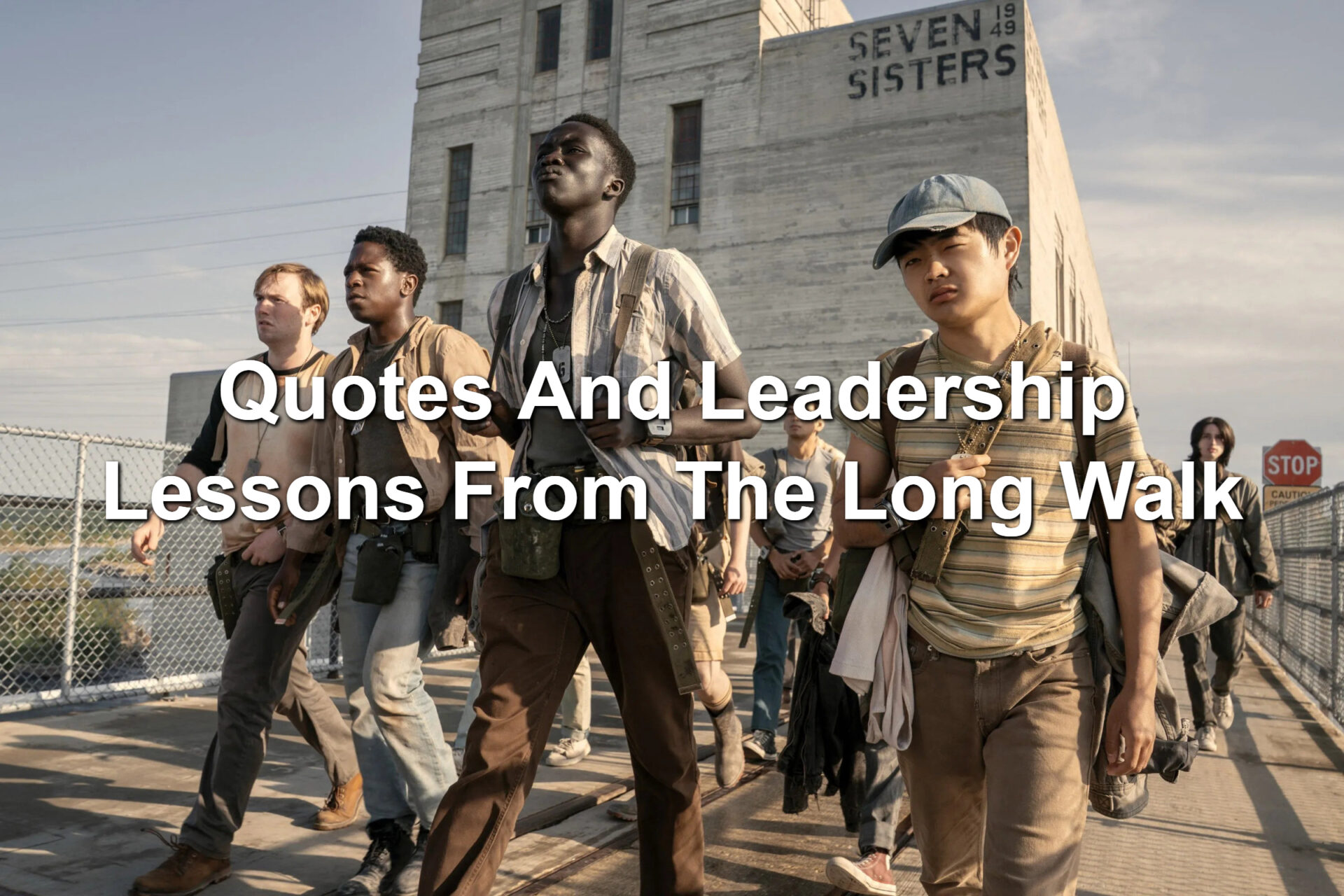
The film focuses on Raymond Garraty/#47 (Cooper Hoffman) and Peter McVries/#23 (David Jonsson). Throughout the competition, the two form an unbreakable bond. A friendship they never thought either could have.
The story is a great backdrop to explore leadership. Let’s take a look at the leadership lessons in The Long Walk.
Quotes And Leadership Lessons From The Long Walk
1. Not every acceptance is a good acceptance:
Ray received a notification that he was selected to participate in The Long Walk. He was to represent his state in the competition.
Being accepted for something seems like a great thing. Except when it could cost you your life.
Ray was ready to lay down his life for a chance to receive the prize and have a wish fulfilled. We learn later on the real reason he wanted to win: to take out The Major (Mark Hamill). The Major had killed his father, William Garraty (Josh Hamilton). It would be poetic justice to turn the tables on The Major.
We have to be cautious about what we’re accepted into.
It could be a new organization: Do the core values line up with yours? Does the organization follow its stated values?
It could be a friendship group: Who are they? What do they talk about? How are they living?
It could be a church: What are their beliefs? How do they treat their community?
Acceptance isn’t always good.
2. Embrace the new leadership jitters:
Ray meets Pete. He asks Pete if he’s ready for the competition.
Pete’s answer? He’s a little jumpy. Maybe that’s okay…
I loved Pete’s answer to Ray’s questions. He’s going to do this thing, even if he’s jumpy. And he’ll be okay.
Don’t let your nerves get the best of you as you start out in leadership. It’s scary. It’s new. But it’ll be okay.
Lead through your jumpiness.
3. Raymond Garraty:
I wouldn’t mind having some money, but there’s more important things.
The boys involved in the competition were talking about the money they could win. Ray says he’d like the money, but there’s something more important in life.
The system that had been created in this dystopian world told the boys that money was the only way out. This belief created a sense of desperation in those who volunteered to be a part of it.
In the end, no one really signs up voluntarily.
Why are you leading? Why are you working? Is it for the paycheck?
If so, I want you to check yourself. The paycheck that comes from your job only goes so far. Sometimes, the paycheck creates a desperation. It can create a set of golden handcuffs.
You get so comfortable with the pay that you forget about the important things. What are those things?
- Your family
- Your relationships outside of work
- The things you enjoy doing
- Your health
Make sure you’re balancing your paycheck with what it can’t offer.
4. Great leaders slow down to help others:
Adam ‘Curly’ White/#7 (Roman Griffin Davis) was one of the boys accepted for The Long Walk. Early on, Curly gets a charley horse. He tries to walk it out but can’t. As he slows below 3 MPH, Ray goes to him.
Ray begins to talk him through the charley horse. He gives him pointers. Through it all, his advice fails. However, what he did was brave, heroic, emblematic of a leader.
He slowed to help someone else.
We’re so focused on getting to the finish line that we forget not everyone can keep up with our pace. We try to push them. We try to tell them of the consequences.
What don’t we do? We don’t slow down to help them.
Imagine slowing down. It may feel wrong. But what if it helps someone else? Could you slow down, then?
Think about this the next time someone on your team is going too slow. Could you slow down to help them?
5. Be careful of wanting tough things to get too easy:
Pete states that he wants the eliminations to get easier. Seeing the other boys get taken out by the guards along the route was disturbing. The thoughts of how they died… the thought that it could be him. It was almost too much.
Ray speaks up. He says he’s afraid the eliminations will get easier. He’s afraid he’ll become numb to the death around him.
When you think about the difficulties of leadership, do you want things to get easier? Do you want it to be easy to terminate someone? Do you want it to be easier to reprimand someone?
Be careful. When tough things become easy, you may have lost your soul.

6. Bad leaders rarely see what they do as wrong:
Gary Barkovitch/#5 (Charlie Plummer) taunted Rank Sanders/#19 (Daymon Wrightly). Rank couldn’t take it anymore and tried to hit Gary. In the process, Rank fell. He stopped moving. He fell below the 3 MPH minimum.
Because he fell, he was executed by the guards.
The other boys felt that Gary had murdered him. Gary didn’t see it that way. He couldn’t accept that he did something to cause Rank’s death.
When you do something wrong, are you able to see it as such? Are you able to accept responsibility?
Your actions may not cause direct harm. The harm may be indirect.
Be aware. Be accepting that your actions will ripple beyond what you think.
7. There are things your team members don’t need to see:
Richard Harknes/#49 (Jordan Gonzalez) twists his ankle. He begins to slow down. Two boys on bikes are watching him. Waiting to see him executed. Arthur Baker/#6 (Tut Nyuot) sees the boys watching. He’s concerned for what the boys will see.
Art starts telling the kids they shouldn’t watch. It’s not good. They shouldn’t be there.
And they shouldn’t. They shouldn’t see what’s about to happen to Richard.
In an effort to be open and honest, we think team members should be privy to everything happening in the organization. The truth is, there are things that they shouldn’t see or know about.
Be careful what you share. Be careful how you share it.
Your team members don’t need to see everything.
8. Raymond Garraty:
I want my wish to change things.
Ray and Pete are discussing what they will wish for if they win. Ray tells Pete he wants his wish to change things.
Why? Because Ray is tired of the competition. He’s tired of The Major. He’s tired of the death (The Major had killed Ray’s dad).
It wasn’t about winning the money. For Ray, winning would mean changing things.
Consider why you’re leading. Are you doing it for money?
Or are you leading to change things in a positive way?
9. Ray and Pete:
Every moment matters.
As the competition narrows in The Long Walk, it comes down to Ray and Pete. Ray begins to tell Pete about growing up and how he never thought about death.
In the end, Ray repeats something Pete had said earlier in the movie. What was that?
Every moment matters.
As you lead your team, recognize that every moment matters. Every moment can leave an impact on someone.
How are you making this moment matter?
10. A leader’s dream/wish can become their people’s dream/wish:
Ray decides to slow down. To stop. He would let the guards kill him. His action would give Pete the win. Pete could then live comfortably and get his wish.
What Pete wished for in the end wasn’t his original wish. No, Pete chose to wish for Ray’s wish: a carbine gun to kill The Major.
Ray so influenced Pete that his wish became Pete’s.
That’s what happens with great leaders. When you lead with integrity, hope, and kindness, your wishes and desires become those of your people.
Lead in such a way that your dreams become the dreams of those you lead.