The late 80s to 90s had a long slate of great anime films. I was brought up on many of those. I fondly remember films such as:
- Vampire Hunter D
- Ghost In The Shell
- Princess Mononoke
- Ninja Scroll
- Neon Genesis Evangelion
- Memories
- Macross Plus
And, of course, Akira. Akira defined what great anime was: beautiful animation, a tight story, action, adventure, and care for one another.

Akira was it.
What was Akira’s story?
Akira is based on a series of manga books created by Katsuhiro Otomo between 1982 and 1990. The film covers approximately the first half of the manga series.
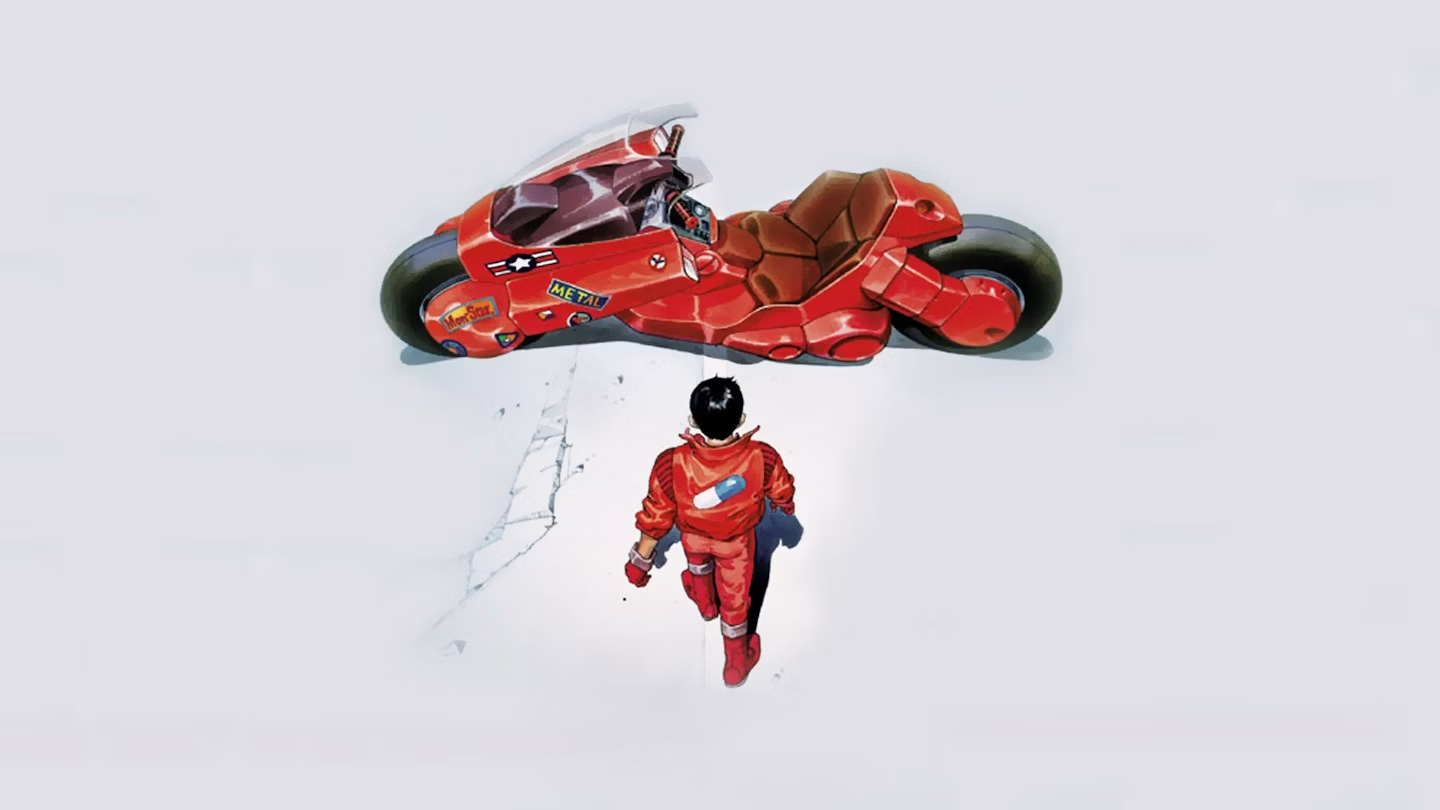
The movie is set in Neo-Tokyo, a dystopian city in a dystopian future, following the aftermath of an event similar to a nuclear bomb. The people of Tokyo had to rebuild, but it was no longer the same. Gangs now ran rampant. One of those gangs was led by Shotaro Kaneda (Mitsuo Iwata), who owned a killer red motorcycle that I knew wasn’t possible, but one I would have loved to own. His friendship with fellow biker and friend Tetsuo Shima (Nozomu Sasaki) is explored as Tetsuo succumbs to rage, frustration, and a longing for power.
All of this is the perfect backdrop for what we do here with Reel Leadership.
Now, I get to look at Akira through the lens of leadership. I get to explore deeper meaning and help you see those things as well.
Quotes And Leadership Lessons From Akira
1. Yamagata (Masaaki Ôkura):
You wouldn’t be so jumpy if you didn’t have anything to hide.
Kaneda’s gang enters a bar. There, the bartender (Yôsuke Akimoto) was jumpy as the members came crashing through.
The bartender asks Yamagata not to barge in. He could enter in a more subdued manner as it frightened him.
Yamagata responded with a quote that is valid, but not for this instance. He told the bartender he wouldn’t be so jumpy if he didn’t have anything to hide (the bartender did as he was dealing drugs).
Are you a jumpy leader? Are you always on edge?
Consider why…
Do you have something to hide? Are you doing something you shouldn’t?
If you’re doing the right thing, most of the time you won’t be jumpy.
2. Kaneda:
This isn’t a game.
Kaneda and Tetsuo are chasing members of the Clown Gang. The Clown Gang is their major rival. They’re also violent and deal drugs.
As the pursuit continues, Kaneda and Tetsuo break off and chase one of the members through an alley. Tetsuo wipes out as they exit. Kaneda is frustrated. He reminds Tetsuo that this is not a game.
Let me remind you: Leadership is not a game. You’re dealing with real lives, real people. Your decisions are impacting the lives of their families, friends, and loved ones.
You have a responsibility to lead well. To lead with confidence.
You can’t lead like it is a game. People will get hurt if you do.
3. Keep your eyes on the mission:
Tetsuo is once again chasing a member of the Clown Gang. The Clown Gang member hits a barrier on the road. The member wipes out and is injured.
Tetsuo takes his eyes off the road. He’s now focused on the downed biker. He doesn’t see what’s in front of him.
There’s a young child, #26, or Takashi (Tatsuhiko Nakamura), standing in front of him. Takashi is an esper who has escaped from the Neo-Tokyo Military Complex. Two others escaped with him. They are:
- #25/Kiyoto (Fukue Itô)
- #27/Masaru (Kazuhiro Kandô)
Tetsuo collides with Takashi. Through the impact, Tetsuo is imbued with psychic powers similar to those of the escaped kids.
While the powers are cool, he took his eyes off the road and had an accident.
Accidents happen when we take our eyes off the mission. We get off course. We drift. We often find ourselves in places we don’t want to be.
Ensure you remain focused on the mission. Have your eyes set forward, unwavering. Even when exciting things are happening around you.
Many leaders fail because they catch the shiny object syndrome.
4. Great leaders help others:
The police arrest Kaneda and his gang members. Earlier, he had seen Ryu (Tesshô Genda) and Kei (Mami Koyama) near the mayhem. He took a liking to Kei.
At the police station, Kaneda sees Kei. He’s taken aback by her beauty again. He knows he has to help her.
The police release Kaneda and his gang. As he’s leaving, he tells the officers there’s still one more member, Kei. His plea gets Kei her freedom.
Kaneda didn’t have to help Kei. His desire to help her stemmed from his passion for her. Still, he did something he didn’t need to.
You’re going to see people who need help along your leadership journey. These people may be your employees, coworkers, vendors, or someone else.
The place you’re in is a place of power. You have the ability to help the people around you. Even if you don’t know them.
Don’t be afraid to extend a helping hand. Great leaders help others.
5. Find your people:
After the accident, Tetsuo was sent to a secret military hospital. The doctors in the hospital begin to experiment on him. Due to his increasing powers, he’s able to escape.
Where’s the first place Tetsuo goes? He goes to one of his people. His girlfriend, Kaori (Yuriko Fuchizaki).
He knew who would listen. He knew who would help.
Do you know who your people are? These are the people who will have your back. They care deeply about you.
They’re willing to stand strong next to you when you need it. They’re also willing to call you out when you take your eyes off the mission or do something stupid.
Find your people. They will keep you grounded.
6. Ryu:
My job isn’t to believe or not to believe. My job is to act or not act.
Ryu is a member of a government resistance organization. He’s a partner to Kei and other resistance members. They have the escaped espers and are trying to help them.
Kiyoko experiences a precognitive vision. She tells the resistance group they will see Akira again. She then asks if Ryu believes.
Ryu’s answer wasn’t a yes or no. He answered that it doesn’t matter if he believes. He has to decide if they must act.
I think Ryu had something right here. He didn’t need to believe or not believe. He needed to act.
Leaders who don’t act aren’t leaders. They’re spectators. They can believe all they want. If there’s no action, there’s no leadership.
7. Uncontrolled power is dangerous:
Tetsuo’s powers continued to grow. They manifested in ways Testuo wasn’t expecting.
A nurse sees that his door is unlocked. A security guard and the nurse go to check on him.
Tetsuo is back in the room. His powers manifested. The nurse and security guard are torn apart.
The powers Tetsuo was gaining were dangerous. He didn’t have them under control.
Leaders hold an extreme amount of power. Their words carry weight.
When used in bouts of anger, frustration, or rage, this power can be dangerous. You can hurt those around you. You can destroy yourself or the organization you’re trying to lead.
Great leaders understand they have to restrain themselves. They can’t use their power for their own gain. Instead, they use their power in a constrained way that helps those around them.
8. Unhealed hurt will continue to hurt:
Tetsuo always felt less than those around him. He was bullied, made fun of, and hurt. The power he gained through the accident didn’t help anything. The increased power hurt him.
He went so far as to kill Yamagata. Tetsuo and Yamagata had been friends since childhood. The three, including Kaneda, had been inseparable.
Now, Testuo’s unresolved hurt and pain led him to kill one of his best friends. His unhealed hurt lashed out and hurt others.
There’s a reason mental health has become such a big deal. People are beginning to realize that hurt people hurt others. Their anguish will eventually break them.
You must be aware of your past hurts. You have to be willing to work on yourself and the pain you’ve been experiencing.
As you begin to resolve the unhealed hurt, you find yourself in a better position to lead.
9. Kei:
You shouldn’t use your powers this way.
Tetsuo wants to kill the three kids who had been experimented upon. He also wants to cause pain to the world around him because Akira, the most powerful child to be experimented on, calls out to him. To do this, he must reach the Olympic Stadium.
Kei confronts him. She tells Tetsuo he has to reconsider how he’s using his power. He’s going to destroy the world.
Does Tetsuo listen? No, he doesn’t.
I’ve already mentioned how unrestrained power is dangerous. How it will cause you to hurt those around you. While similar, you also need to understand that there’s a right way and a wrong way to use your power.
You have unique skills and talents. Others may even desire them. They see you leading with ease or finding solutions to problems no one else can.
Don’t use these talents to hurt others. Use your powers to help others.
10. Unrestrained power will corrupt you:
By the end of Akira, Tetsuo’s power had corrupted him. Absolutely corrupted him.
Tetsuo devolved into a gelatinous blob. He was hideous. He couldn’t control himself.
Tetsuo now sees his need for others to help him.
There’s an old saying that absolute power corrupts absolutely. It’s true more often than not.
When people hold absolute power, they are corrupted by it. They begin to do things they wouldn’t. Say things they shouldn’t. Feel ways they couldn’t before.
Beware if you’re gaining absolute power somewhere. There’s a good chance it could corrupt you.