Darkman is such a fun film. It’s your typical ’90s fare that seems like it could even be a comic book movie (it wasn’t but did inspire a Marvel Comics series and later a Dynamite Comics series), but with a big name you wouldn’t expect today. Liam Neeson stars as the mild-mannered scientist Peyton Westlake. He has his lab on the upper floor of his loft apartment. His life changes when mobster Robert Durant (Larry Drake) seeks out a document Peyton’s girlfriend, Julie Hastings (Frances McDormand), had uncovered. The document details bribes that developer Louis Strack, Jr. (Colin Friels), offered in exchange for a waterfront development.
Durant goes to Peyton’s apartment searching for the document. He finds Peyton and his lab assistant, Yakitito (Nelson Mashita), there. He pries them for information. Neither would budge. Durant decides he’s had enough.
Durant and his thugs beat Peyton to within an inch of his life. They believe he is dead when they blow up the apartment. But that’s not the case.
Peyton is found badly injured. His face and body are disfigured. The hospital couldn’t identify him because of his injuries. He’s logged in as a John Doe. As he’s being treated, he’s given the experimental Rangeveritz technique. The Rangeveritz technique involved major trauma to his body. Doctors severed his thelmic nerve, resulting in him no longer being able to feel pain or any physical sensation. The procedure also gave Peyton superhuman strength and endurance, especially when his adrenaline flowed.
He escapes the hospital and goes on a mission… To get revenge on the mobsters who did this to him.
He must become Darkman.
The story is cheesy, yet fun. It’s typical ’90s fluff. But it’s good fluff, especially with Sam Raimi (from Army Of Darkness) directing the movie.
Let’s look at Darkman and the leadership lessons hidden within this cult classic.
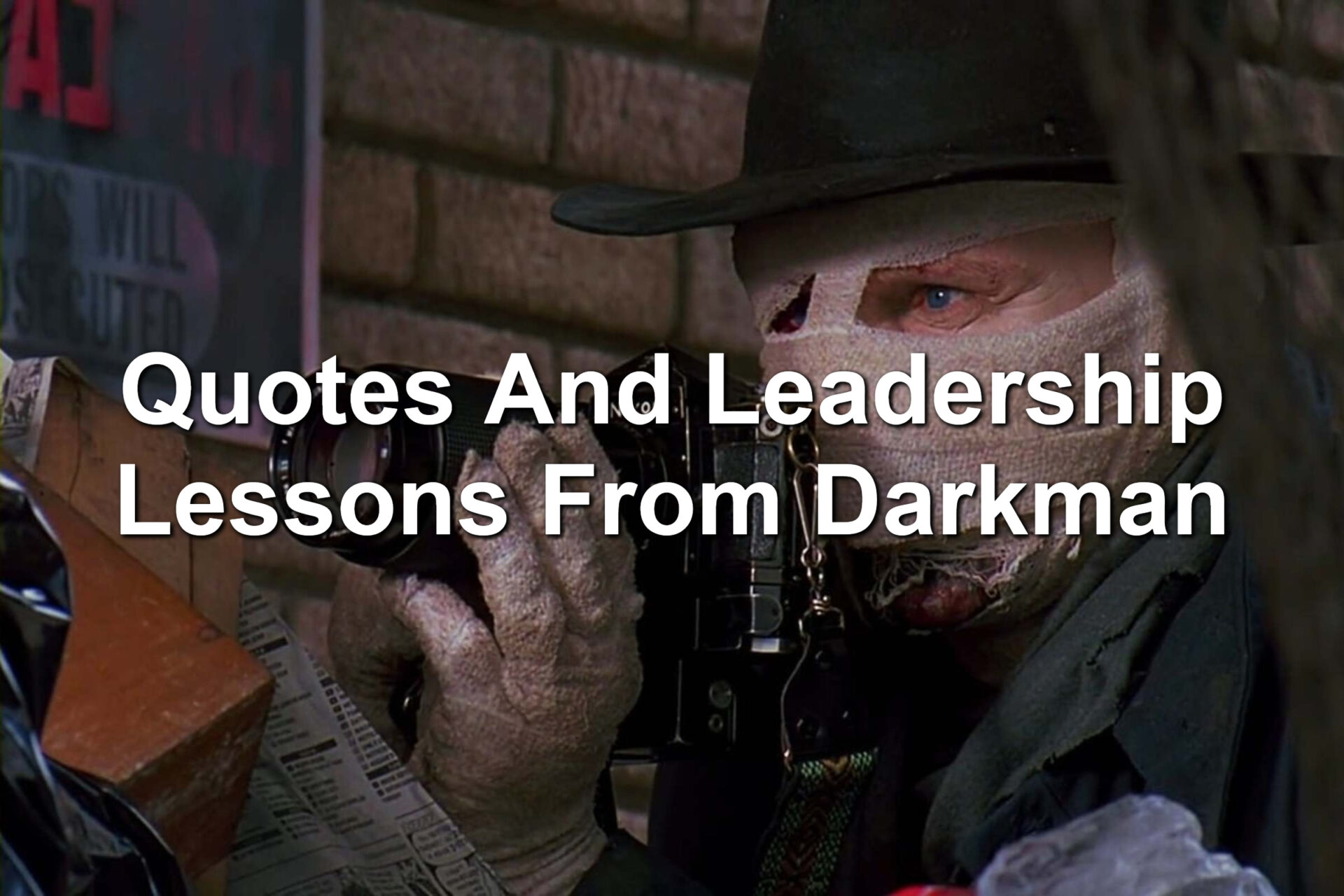
Quotes And Leadership Lessons From Darkman
1. You can never be too cautious:
Durant and his mobster associates had gone to the docks for a meetup. There, the people they were meeting with checked them for weapons. Durant and his people were loaded. They handed their weapons over.
Well…
All but one.
One of the mobsters had a wooden leg. There was a disguised gun. One of the mobsters pulls it off his body and mows down those they were meeting. He killed all but one man: Eddie Black (Jessie Lawrence Ferguson).
Eddie’s people were cautious. But they weren’t cautious enough.
You may think you’re thorough. You’ve checked every nook and cranny for issues. But you didn’t go quite far enough.
Being overly cautious is dangerous, but not being cautious enough can be just as dangerous. Make sure you’re checking out the people you’re doing business with. Make sure you know your employees.
When you’re cautious, you can prevent catastrophe.
2. Peyton Westlake:
Why, why, why?
Peyton and his assistant, Yakitito, had been trying to develop synthetic skin for skin graft procedures. This would help countless numbers of burn victims. There was a problem. They couldn’t get the synthetic skin to last longer than 99 minutes. After that time, the skin would dissolve into a disgusting puddle.
Every time the two failed, Peyton would become frustrated. Peyton wondered why the cells were unstable. What prevented them from holding together?
He cried out, “Why, why, why?!?”
He had a sincere desire to understand the problem. He just couldn’t solve it.
When you face failure, what do you do? Do you get angry? Or do you ask why?
Why is a great question to ask when you run into failure. You can examine the situation, see what you did and didn’t do, and see if there’s a change you can make.
When you ask why, you can look for a way to make things work.
3. Bad leaders will often have good reasons behind their actions:
Julie confronts Louis Strack, Jr. She had discovered a paper detailing bribes and payouts to get his development going.
Strack has an answer ready. He tells Julie there’s a bigger picture at play. Just look at the model of what could be.
Strack thought his development was a good reason to do wrong. He was wrong.
Bad leaders may not always start off as bad. They may have good reasons for doing what they’re doing.
The businessman who begins to skim a little money off the top to help his sick child. Or the mother who steals a loaf of bread to feed her family.
Their actions are wrong but their motives had a good reason.
The more they took these actions, the bigger the slight was. More money was skimmed, bigger things were stolen. None of it was right but there was a good, but misguided, reason behind the initial action.
Make sure you’re not doing wrong actions for what you believe is a good reason. You’ll find yourself slipping further and further away.
4. Computer (Bridget Hoffman):
Insufficent data.
Peyton returns to his charred apartment and lab. He finds his computer still functional. He wants to create a synthetic mask for himself.
To do this, he has to feed a photo of himself into the computer. All he has is a burnt photo of himself. It’s missing portions of his face.
Still, Peyton feeds the photo into the computer. The computer attempts to digitize a mask of Peyton’s face. The computer eventually tells Peyton there is insufficient information to make the mask.
I feel as if many leaders are Peyton in this scenario. We want our employees to do a job. We give them some information to do it. But we don’t give them sufficient information.
Our employees flounder. They try to achieve the desired results. But they can’t. They’re stuck with insufficient data, insufficient resources.
Don’t be the leader who gives their people insufficient data. Make sure they have the whole picture.
5. Mimic others:
Peyton takes pictures of Pauly (Nicholas Worth), one of Durant’s associates. He gets photos of Pauly’s face, hands, etc..
These photos are crisp and clear. He feeds them into the computer. The computer digitizes replicas of Pauly’s body.
Peyton then uses this to mimic Pauly.
While Peyton went to extremes to mimic Pauly, and for reasons of revenge, there’s something we can learn here. It’s okay to mimic the actions we see in good leaders.
What does that mean?
- Mimic good actions
- The person you mimic may be a mentor or respected leader in your organization
- You can learn from your mimicking
When you mimic someone, you repeat what they do. Do this enough times, and your actions become second nature. It’s powerful when you mimic a good leader and their great actions.
6. Peyton Westlake:
Dear God, what have I become?
Peyton had been a mild-mannered scientist. After the experimental treatment, Peyton became something else.
He framed Pauly. Because of the framing, Durant threw Pauly out of a window.
Peyton brooded on a roof. He wondered what he had become. He had changed drastically and, in his mind, not in a positive way.
When Peyton realized his actions were against his former moral compass, he had to consider what he had become. We must do the same as we lead.
Constantly examine your actions. Think about whether or not they are:
- appropriate
- something you are proud of
- whether or not you should do them again
- aligning with your values
The more you focus on your actions and whether they align with who you are, the easier it will be to correct those that don’t.
7. Peyton Westlake:
I’m a scientist. Think objectively.
Peyton knew who he was. He was a scientist. More importantly, he knew what scientists do: Think objectively.
This happened after he lost control. He smashed up his laboratory. He destroyed things. He wasn’t thinking objectively.
He had to stop and remind himself of who he was and how he should think.
Guess what? You’re a leader. Do you know what leaders do? They lead.
When you get off course, remind yourself that you’re a leader. That you need to lead. And lead well.
8. Anger will cause you to do things outside of your character:
Peyton took Julie to the carnival. He was wearing one of his synthetic masks so she didn’t know his face was horribly disfigured. She also didn’t know about the experimental treatment Peyton had been subjected to.
At the carnival, Peyton wants to win a pink elephant for her. He knocks down the targets. He’s excited he’s won.
But then the carnival worker (John Lisbon Wood) tells Peyton he hadn’t won. He had been over the line.
This is when Peyton crossed the line. He let his anger take over. He took the carnival worker’s fingers in his hand. They’re crushed.
Peyton let his anger take control. When anger controlled him, he did things he didn’t want to do.
We do the same thing. Anger will cause us to do things that are outside of our character. We will find ourselves yelling, screaming, demanding things.
Be careful of your anger. Don’t let your anger get out of control.
9. Others are willing to help if you let them:
Julie finds Peyton’s lab. She sees his synthetic mask disintegrate. She wonders why Peyton thought he had to lie.
Her other reaction was one of care. One of wanting to help him.
Julie told Peyton she would have helped him had he come to her. She was there for him.
Leaders often say leadership is lonely. There’s plenty of reasons of why leadership is lonely.
Yet, I think one stands out more than any other:
We’re afraid to ask for help.
Don’t be afraid to ask for help. People want to see you succeed. They want to be a part of your success.
But you have to let people in. If you don’t, they can’t help you.
10. Learn to recognize your teammates:
Peyton attacks one of Durant’s thugs. He puts a mask on him. Then he sends him back out to the other mobsters.
Guess what happened? The mobsters didn’t recognize him. One of them shoots the thug and kills him.
All because he didn’t recognize him.
We must know who we’re working with. Even if something comes up, we have to be able to recognize our teammates.
This can help alleviate a lot of issues.
Know who your people are. Understand who they are.