Fifteen years ago, we saw the release of the DreamWorks animated film How To Train Your Dragon. Since then, we’ve had two sequels and several animated series. Each one digging deeper into the lore of this animated world and fleshing out characters.
Now, we’re treated to what may be one of the best well-done animated-to-live-action translations. This How To Train Your Dragon changed slight aspects of the original but stayed faithful overall. My wife and I thoroughly enjoyed our outing to the movie theater to catch this film.
What is How To Train Your Dragon about?
The isle of Berk is home to a village of Vikings. They’ve been at war with the dragons who inhabited an unknown island nearby. The Vikings have vowed to destroy the dragons before the dragons can wipe them out. It’s a battle for the ages.
But does it need to be?
We meet young, inventive Hiccup (Mason Thames). He’s almost a pacifist but wants to make his father, Chief Stoick (Gerard Butler), proud of him. To do that, he must kill a dragon.
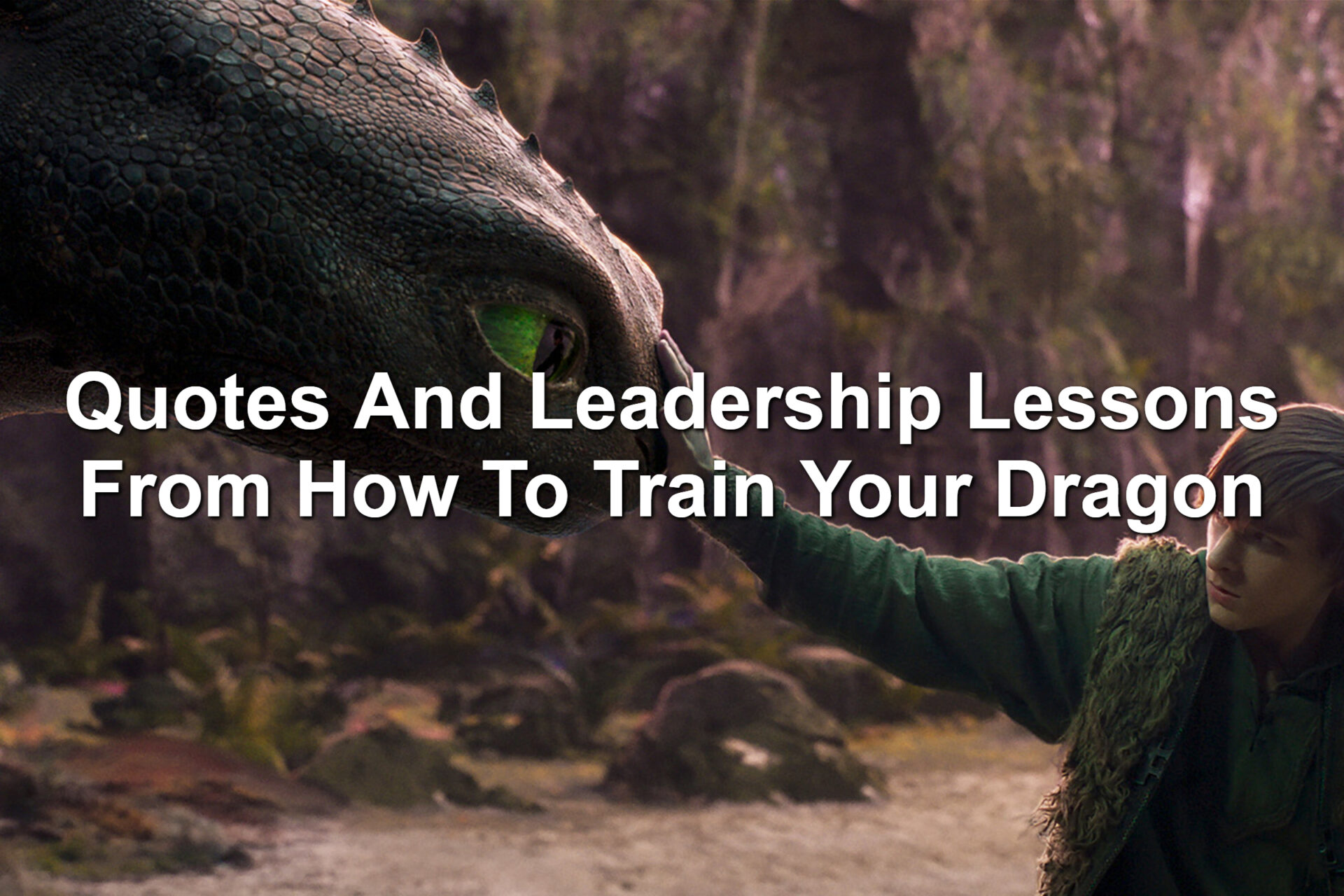
His efforts led him to capture a young Night Fury dragon, which he names Toothless. When he went to kill the dragon, he couldn’t. Instead, he befriends the dragon, creates an artificial tail, and changes the course of Berk’s history.
Through all of this, we can see shining examples of leadership. Let’s explore those in the latest Reel Leadership article.
Quotes And Leadership Lessons From How To Train Your Dragon
1. Your initial solution may not be the best:
The village of Berk needed to kill the dragons. The dragons had been a problem for the village for as long as they could remember. Their war had even led to Hiccup’s mother being presumed dead. How could Hiccup not hate the dragons?
The villagers had decided to take the fight to the dragons. They would go to the dragon lair and slaughter every last one of them. The people of Berk searched and searched for the lair. They couldn’t find it.
Their plan did not go well.
By the end of the movie, the villagers had a different solution. They would befriend the dragons and they could live in harmony.
We think our first idea, our first solution, is often the best. We don’t go much beyond that initial thought.
But we must. Our initial solution often leaves much to be desired.
There’s refinement, understanding, and changes that need to be made. Examine your first solution, but don’t be married to it. There are many other solutions that could work better.
2. Don’t be so quick to celebrate:
Hiccup had invented a device that would shoot bola snares at dragons. He hadn’t tested the device but when a dragon raid attacked the village, he knew it was time to give it a go.
He moves the bola launcher to a prime location. His eyes scan the horizon. He sees something moving in the darkness. That’s his moment. He launches the bolas and hits a dragon.
Time to celebrate!!!
Maybe not.
Hiccup begins his celebration. He’s excited. But then another dragon appears right behind him.
It was too early to celebrate.
I love a good celebration. I believe every organization needs to celebrate its wins.
However, I also believe they need to know the proper time to celebrate. It’s often not right after a major victory.
You have to ensure that the win is solid. That it isn’t going to go sideways.
Once you have made sure that your win is good, celebrate. But don’t do it too early!
3. Gobber (Nick Frost):
You can only prepare him.
Stoick was concerned about Hiccup. He wanted Hiccup to be a valiant warrior. One that could become chief of Berk. He didn’t see that happening.
Stoick shares his fears and concerns with the village’s blacksmith, Gobber. He tells Gobber he doesn’t know what to do with Hiccup. He’s not sure what he will become.
Gobber had great advice. You can only prepare others. You can’t control the future.
What powerful leadership advice. You have a team you’re leading. You’re giving your team the tools (I hope), support, and guidance they need.
There may still be concerns for their futures. You may not know how they’ll respond all the time.
As long as you prepare them, you’ve done your job. Do what you can to prepare them and leave the rest up to them.
4. Established wisdom can be wrong:
Gobber was given the task of training the kids of Berk. He had quite the task ahead of him, especially with the kids he had to train this time around.
Gobber had:
- Fishlegs (Julian Dennison)
- Ruffnut (Bronwyn James)
- Tuffnut (Harry Trevaldwyn)
- Snotlout (Gabriel Howell)
- Astrid (Nico Parker)
And, of course, Hiccup.
Fishlegs, Ruffnut, Tuffnut, and Snotlout weren’t the best of the best. They were going to struggle to be dragonkillers. Astrid, on the other hand, was the best of the best. She knew how to fight.
During their training, Gobber tried to prepare them for anything coming their way. He passed down ancient Viking wisdom.
One of those pieces of wisdom was that dragons will always go for the kill.
Something didn’t sit well with Hiccup when he heard this advice. He knew it wasn’t right. Toothless, the Night Fury dragon he’d captured with the bola snare, hadn’t tried to kill him. This meant dragons don’t always go for the kill.
We get leadership wisdom passed down to us through the ages. We hear the platitudes, advice, and guidance again and again. So much so, we begin to believe the established wisdom is always correct.
What if it’s not? What if there’s been a change, new information discovered, or your way of leading changes things?
We have to be willing to challenge conventional wisdom. We must see if new research, insights, or ideas have been presented.
The world is changing. The wisdom we once thought immovable may have shifted.
5. Some people want more, others want less:
Astrid tells Hiccup she has her eye on their big house. She wants to become chief, to get the responsibility, to be the big shot.
Guess what Hiccup didn’t do? He didn’t protest. He said that would be fine.
All those things weren’t his dreams. He wants something different.
We think everyone aspires to become a leader or TikTok famous or wealthy. Truth be told, that’s not everyone’s dream.
Some people want a simple life. They want to do their work, do it well, and be rewarded for it. They don’t desire the added stress, frustration, or irritation that comes with leadership.
Don’t think less of those people. There are those who always long for more and those who want a simple life.
Neither is wrong.
6. Being in the presence of great leaders impacts you:
The young Vikings had to take on a two-headed, fire-breathing dragon. The fight didn’t go well. Fishlegs, Ruffnut, Tuffnut, Snotlout, and Astrid were all defeated. Only Hiccup was left.
The dragon approached Hiccup. It sniffed him. Then the dragon backs away.
Why?
Hiccup had been in the presence of a Night Fury, a powerful dragon. The smell of Toothless had rubbed off on Hiccup. The dragon recognized this.
The more you’re in the presence of great leaders, the more their scent rubs off on you. What do I mean by that?
- You learn what you see from other leaders
- You take on their traits instinctively
- You begin to respond in similar ways
- You start to look like them
Get in the presence of great leaders. The more you are, the more they can rub off on you.
7. Hiccup:
Let us show you.
Astrid finds out that Hiccup had been consorting with a dragon. He hadn’t killed it. Hiccup’s familiarity with Astrid tripped her out.
Astrid runs away. She’s running when Hiccup and Toothless grab her. They bring her to an elevated rock where Hiccup tries to talk sense into her.
He pleads with her. Eventually asking her to let them show her that Toothless isn’t a threat.
And they do. They show her the truth about dragons.
You have more insight into the goings-on of your organization than the boots-on-the-ground employees do. You’ve been given the big picture. They haven’t.
When they’re confused, frustrated, or angry, show them what is going on. And why.
You have to show your team what’s happening. When you don’t, they’re left in the dark.
Light their way. Give them the information they need.
8. Hiccup:
It’s not the dragon I’m worried about.
Stoick had given a mighty speech. He shared how proud he was of Hiccup. How Hiccup was finally becoming a true Viking. Hiccup would be able to prove himself by killing a dragon in the ring in front of all the other Vikings.
Astrid tells Hiccup to be careful with the dragon in the ring. She didn’t want to see him get hurt.
Hiccup wasn’t worried about the dragon in the ring. He knew the dragon wouldn’t hurt him. What Hiccup was truly afraid of was his father and the other Vikings.
What we see as a threat often isn’t. It’s not the big, bad, scary thing right in front of us.
The true villain, many times, can be the leadership of an organization.
They’ve lost their vision or they’ve detoured from the mission. They’ve decided who is good and who isn’t.
The leadership has created a toxic culture that calls for the destruction of someone or something else.
Be careful not to become the villain of your organization. You can become the villain quicker than you think, especially in times of trouble and stress.
9. Remember how scared you were:
Hiccup recalls why he couldn’t kill Toothless when he found him. The look in Toothless’ eyes reminded Hiccup of himself.
Why was that?
Toothless had a look of abject fear in his eyes. He was terrified. He was scared.
Guess who else was scared? Hiccup.
He couldn’t hurt something that was just as scared as he was.
When you began your career, you were probably nervous or scared. You didn’t know the ropes, how the culture worked, or how to do things well.
You learned those things over time. It took failure to grow into the person you are today.
Those people you’re leading… They’re just as scared as you were.
They don’t want to mess up, fail, or upset the status quo. They want to do the right thing but there’s fear there.
Remember your start. You’ll have more empathy for those you lead when you do.
10. Our attempt to protect others can have a damaging consequence:
Stoick admits to Hiccup that he was scared of Hiccup being hurt. So, Stoick had done his best to protect Hiccup. It’s what he was supposed to do as a father.
However, Stoick’s attempts to protect Hiccup stunted him. Hiccup struggled to become the man he was meant to be because his father didn’t see what Hiccup could do. Stoick saw the only path to safety as the one he’s always followed: brute strength.
We tend to try to protect our people in the way that we have been trained up. That could be done by eliminating the bottom 5% of performers. It could be through ruthless budget cuts. You may try to protect others by not allowing them to discover their giftings.
We can’t keep protecting people the same way we have always done. We have to be willing to let our people get hurt. THEN we have to be willing to help them tend to their wounds after discovering what works and what doesn’t.
Allow your people to explore their giftings, fail, and then pick them up.