What if the tale of Robin Hood that we’ve come to love and know isn’t true? What if Robin Hood’s true exploits were much darker? That’s what we get to explore in A24’s The Death Of Robin Hood.
We enter the story of The Death Of Robin Hood as Robin Hood (Hugh Jackman) is wrestling with his past. He was a criminal. More than that, Robin Hood was a murderer. And he enjoyed it.
Robin Hood and his merry men weren’t merry because they were helping the downtrodden. No, they were merry because they enjoyed the violence, chaos, and death they brought to the world.
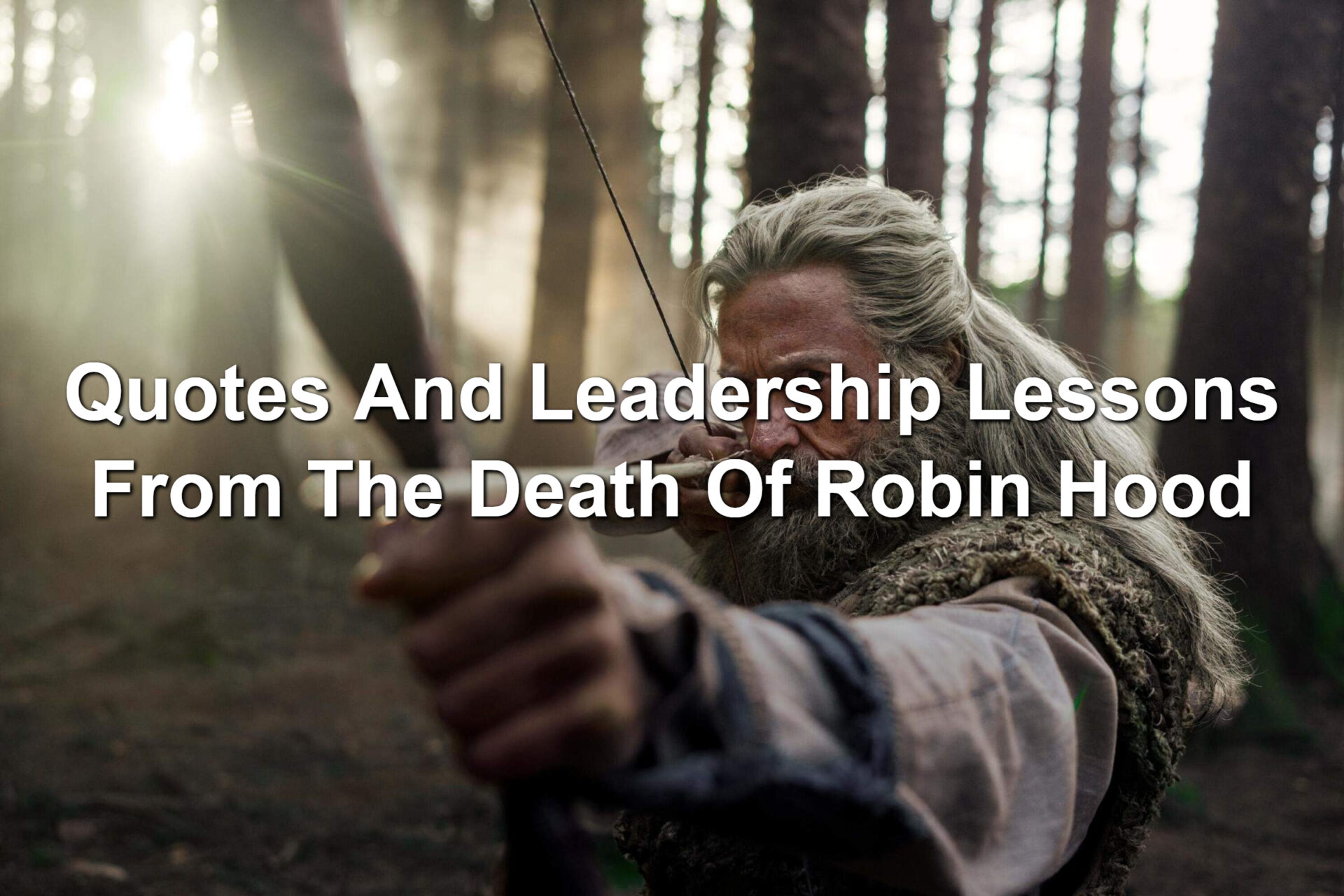
Robin Hood believes his life is over after a bloody battle. He’s bruised and beaten. Death is at his door. Or is it?
He’s saved by a woman, Sister Brigid (Jodie Comer). She’s a prioress who helps restore people. She also has a past that intertwines with Robin Hood’s.
The film is very reminiscent of the Marvel film Logan. It’s a dark take on Robin Hood.
His final tale doesn’t disappoint in the aspect of leadership lessons. There’s plenty to learn from The Death Of Robin Hood.
Quotes And Leadership Lessons From The Death Of Robin Hood
1. Not all leadership tales are true:
The Death Of Robin Hood opens with a young girl finding a feral Robin Hood. He’s wild, unkempt, dangerous.
We’re led to believe that she’s a scavenger. She’s looking for help. But she’s not. She’s looking to take Robin Hood’s life.
Before that, Robin Hood shares that the tales of his heroics are not true. The tales had been spun. They made him look good.
Yet, Robin Hood was a bad, bad man.
We often hear stories about great leaders. Or maybe it’s about leadership events. The stories sound good. They make us feel good.
But are they true?
Many of them are not true.
I recently learned about Ernest Shackleton placing an ad in a newspaper. The tale goes that the ad was looking for men. There was a hazardous journey ahead. The wages would be small. The weather would be bitterly cold. They would face months of darkness and constant danger. Their safe return would be doubtful. But if they were successful, honor and recognition would be secured.
According to many sources, this tale is not true. It’s likely a myth.
Be cautious when entertaining leadership tales. They may sound good but they may not be true.
2. Robin Hood:
It’s not your farm.
Little John (Bill Skarsgård) comes to Robin Hood. He begins to share how he had met a family. He killed the man, Edward. Not only did he kill Edward, but he also took his name, his wife, and his farm.
The original Edward’s family was furious. Now, Edward’s family has come to reclaim the farm. They drove John out.
John has now come to Robin Hood to ask for his help in getting his farm back.
Robin Hood answers in an unexpected way. He tells John that the farm isn’t his.
What a peculiar answer for a thief.
Here’s the thing: we never truly own anything. Even our leadership positions.
We hold them in high regard as a trusted person. We are to tend and care for the position. But we’re to give up our leadership position when the time comes.
Remember, leadership is never yours. It’s only borrowed.
3. John:
There’s many places to begin again.
John shows Robin Hood a picture of his young girl, Margaret. He’s so proud of her.
Robin Hood had felt lost for years. John believed Robin Hood could begin again. All he had to do was find something to believe in.
You may have lost your leadership position. Maybe you’ve lost your love for the position you’re in.
You’re not married to an organization. There are many places to begin again.
4. Leaders are willing to stand in the place of their people:
One of Edward’s family members comes looking for John. He needed to avenge the deaths of his sons and grandsons. He was out for blood.
John is inside the house. Robin Hood is outside. Robin Hood sees the man. He allows the man to attack him instead of John. He’s standing in the place of one of his people.
Even if it were to cost him his life.
What do you do when you see your people struggling? Or maybe you see failure looming?
Do you step in? Do you ask them if they need help?
Great leaders don’t leave their people to flail, to struggle. They’re willing to place themselves between the challenge and the employee.
Be willing to stand in the gap.
5. Sister Brigid:
Do you understand my words?
After the battle, John drops off a severely wounded Robin Hood to the prior. Robin Hood awakens to see Sister Brigid.
She’d tended to his wounds. She was in the process of helping him recover.
Then she asks him that question… Does Robin Hood understand what she’s saying?
How often do you take the time to step back and ask your team members whether they understand what you’re saying? If you’re like most leaders, it’s rarely.
Your words can sound like a foreign language to the people you lead. KPIs, rightsizing, synergy, OKRs, OGSMs, MBOs, and the list goes on and on.
Words, abbreviations, codes…
We have to be careful when using leadership speak. Be willing to ask the room if they understand what you’re saying.
Many people will fail to ask what you’re saying because they’re scared of looking dumb. You can help them through that by asking if they understand.
6. What was once easy may not be easy anymore:
Robin Hood had been gravely injured. Yet, he was recovering. He still had a long way to go. Sister Brigid even warned him to be careful.
Did that stop Robin Hood? No. He went out, found an axe head, a stick, and some feathers. He builds himself a new bow.
When he goes to pull back the string, he finds out he doesn’t have the strength he once did. What once came easily was now a difficult task.
As we get older, we think leadership should become easier. But does it? I think there are areas where leadership does become more difficult.
You may not:
- Pick up on new technology like you once did
- Understand new slang
- Get the new culture
Just know things don’t always get easier the older you get. Sometimes it gets harder. This doesn’t mean you can’t learn new things or interact with a younger team. You only have to understand your limitations.
7. Leaders can take on the responsibilities of others:
A Leper (Murray Bartlett) brings news to Robin Hood. His friend, John, has passed away. That’s not the only thing The Leper brought him.
There was a young girl on the boat. Little Margaret (Faith Delaney). John’s daughter.
Robin Hood took the young girl under his wing, even if it was reluctantly. He made sure she was safe from Edward’s family.
Sometimes, life gets in the way of things. Your team member has a sick spouse. They find out they have cancer. A new child is born.
What was once a priority for your team member has now become something in the back of their mind. They have more important things to deal with.
Consider whether or not you need to take on their responsibilities. In doing so, you can help them in their time of need.
8. Sister Brigid:
Knives cut bread as well as they do flesh. It’s a question of balance.
Robin Hood and Sister Brigid are sitting around a fire. They’re discussing whether or not the island has magical powers. Then the discussion shifts to something else.
Balance.
Sister Brigid tells Robin Hood that balance is critical. It has a say in things. Balance brings people together.
Do you have balance in your organization? Do you bring together the right people for the right time for the right task?
Make sure you’re finding balance in the time you’re putting in. Find balance in the people you bring in. Find balance in the time outside of work.
9. Give team members a chance for something better:
Arthur (Noah Jupe) arrived on the island. He had come seeking help. He was badly injured.
Or was he?
In truth, Arthur was seeking out Little Margaret. He wanted to kill her for what John did to his family.
Robin Hood began to sense something wasn’t right. One day, he tells Arthur he thinks he sees his family. He takes Arthur out on the boat. We all know there’s no family where he’s taking him.
But Robin Hood wasn’t out to kill the young man. Instead, he gave Arthur a choice. A chance for something better. And it appears Arthur took heed and went back to his family.
How do you respond to a team member who makes a mistake? Is it a freak-out moment? Is everything going to end? Will the world never be the same?
Or…
Do you help them find something better? A way to make things right?
Great leaders give second and third and fourth chances. Especially when they see potential in their team members.
Give people a chance for something better.
10. Sister Brigid:
I owe this life to you.
We discover that Robin Hood had murdered Sister Brigid’s husband years ago. This ripped Sister Brigid apart. It also sent her on a path that she never would have expected.
That path was something good. She was able to help people. To care for them.
Without the evil deeds of Robin Hood and his band of men, Sister Brigid wouldn’t be where she is.
And she was good with that.
Sometimes, bad things happen to us. A team member betrays us. An organization collapses. We lose our job.
Don’t think life is over. The situations you’re facing could be leading you to something different, maybe even better.
We owe our lives to the things that have happened to us.